关于我们
我们是一家全球性企业,在紧固与装配领域拥有卓越的制造专长。
作为家族企业,我们秉承百年匠心,始终从容应对时代挑战。从 19 世纪发明按扣和定制弹簧卡扣,到如今为太阳能组件装配和新能源汽车的热管理系统等提供连接解决方案,我们始终坚持创新,持续发展。
There’s no mathematical equation that will give you the answer to if and when a threaded fastener should be used in an application, but there are guidelines to follow for an educated decision.
Threaded fasteners can be used in any application where a threaded joint is deemed necessary for the proper assembly or continued safe use of a product.
When selecting the ideal threaded fastener for an application, one must consider the:
• Loading expectations
• Vibration
• Risk of failure
• Serviceability
• Assembly environment
• Number of required fastener assemblies
The fasteners and load expectations are typically determined by a manufacturer’s R&D department and based on the end product. In some cases, the expected loading is small or the risk of failure so little that threaded fasteners are unnecessary. A non-threaded joint would then be sufficient.
However, when the loading of an application is great and the risk of failure is high, standard nuts and bolts are required.
But what about for the millions of applications used in high-speed assembly environments or that are in the mid-loading range? For example, these are applications that require bolt sizes between #6 screws, 3.5mm in nominal diameter, to M12s or 1/2-inch screws. In these instances, self-retaining threaded fasteners are the ideal choice over conventional nuts and bolts.
The benefits of self-retaining threaded fasteners
• Available in options to meet loading expectations
• Reduce assembly time
• Reduce floor space in an assembly plant
• Can be installed as part of an assembly
• Serviceable
To choose the proper self-retaining threaded fasteners for an application, consider the following.
The assembly environment
In assembly-line or sub-assembly stations, one of the threaded-fastener components should be fixed, and this fixed component eliminates the need for two hands or two operators to assemble the component.
The pre-assembled threaded fastener to the fixed component prevents the need to go behind the panel, maximizing the assembly floor space. Additionally, because the fixed nut is superior in screw-holding strength, it reduces strip-outs when threading directly into panels. Self-retained fasteners can also expedite assembly in the field.
The thread type
The thread type is largely dependent on the selected screw size.
Some considerations:
• Machine screws generally use a tapped barrel or nut retainers
• Coarse thread screws primarily use u-shaped speed nuts
• Common screw sizes, such as the M6x1.0, 1/4-20, and #8 (ST 4.2) screws are available in both types
Nuts with prevailing (as opposed to non-prevailing) torque are preferred for most joints, particularly when using plastic components or in high-vibration applications. Non-prevailing torque nuts are recommended for joints that have less vibration and loading, or that require frequent disassembly.
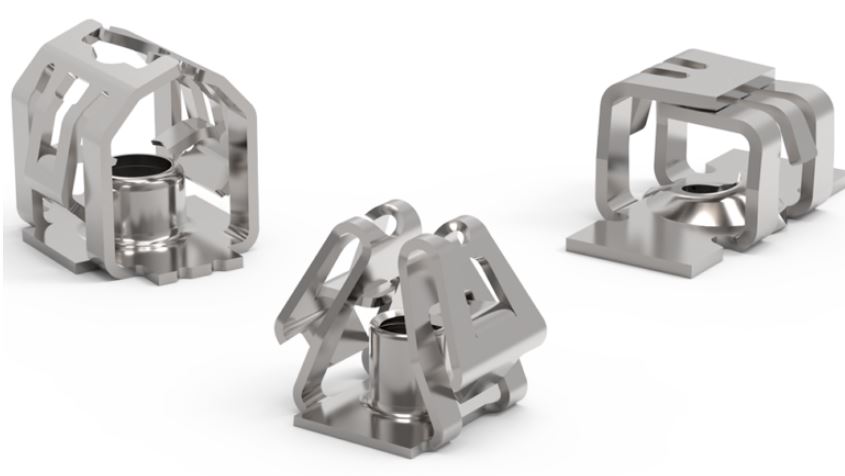
Expansion nuts can provide a fast and vibration-resistant solution when attaching components to blind or center-panel locations where only one side is accessible. They easily snap into rectangular holes and are self-retaining by spring legs.
The orientation
Component orientation is a key determinant when selecting a product family. After considering the screw size, thread type options, and assembly environment, a designer must determine the orientation of the components for assembly.
Every fastener has specific requirements, and some features are more critical, depending on the family selected.
U-nuts
A u-nut can be used if the components for assembly are parallel to one another, have sufficient thickness to withstand loading, and can have two concentric holes punched into them. However, the panel size and material must be robust enough to handle the loading and vibration.
All u-nuts have a recommended minimum-to-maximum panel range. If the panel is near the high end, insertion efforts will be higher, but the retention will be greater. If the panel is near the low end, the insertion efforts are reduced.
The throat depth is a critical consideration when choosing a u-nut. It’s defined as the distance from the edge of the panel to the centerline of the hole and is typically 2 mm shorter than the distance from the inside edge of the u-bend to the centerline of the screw receiving feature. If the throat depth is too small, the u-nut will not engage. If it’s too long, the u-nut will hang too far over the edge.
Expansion nuts
An expansion nut can be used if the components for assembly are parallel to one another, have sufficient thickness to withstand loading, and can have one rectangular-shaped hole co-centric with a round hole. Like with the u-nut, the panel size and material must be durable enough for the loading and vibration.
The panel thickness is important. If the part is over the high end, the clip will not engage. If the panel is too thin, the part will rattle. It’s common for the panel thickness to be decided upon after the expansion nut is chosen to “design around the part.” However, the size of the hole must meet the drawing specification for the part to work properly.
Following a few simple guidelines when choosing the proper nut to secure a bolt can ensure a solid, reliable assembly. It can also minimize the assembly time and maximize profits.
Written by Robert Taylor
Product Line Manager | ARaymond
全球网络,本地服务
联系我们在您所在地区的专家公司所在地
获取联系方式